This book, by Susan Kreller, is well worth a read. Mascha, an introverted 13-year-old living with her grandparents after her mother's death, comes across two younger children--Julia and Max. She discovers that the two are being abused, their young bodies bruised and scarred, and their minds even more so. When she seeks help, however, Mascha is silenced: her grandparents question her interpretation of what she has seen and insist that the children's father is a good man, well-respected in the community. Even 9-1-1 won't believe her story.
Eventually Mascha takes matters into her own hands and locks the two children in an abandoned blue shack in the middle of a barley field. She goes to great lengths to bring them food, water, and items of comfort, but they nevertheless fall into a state of physical and psychological distress in what becomes a sweltering prison. All three children are well beyond their depth.
In the end, when Mascha is found out, her grandmother's words are so telling. "Does anyone ever think about me?" the old woman asks. "Did we know that no one would talk to her anymore, and she could just forget going to exercise class, and she might as well drown herself," Mascha asks.
I must say that the book, and the people within it, are far too familiar. The denial of abuse is common. I have seen a church community take a neutral stance when it comes to what's going on beneath its surface. People don't want to tangle with an abuser, or uncover the truth. Instead, 'good' church folk conclude that rather than take sides, they will remain 'neutral.' They effectively isolate the victim and reinforce the abuse. Most repugnantly, they say "hi" to the victim in a friendly tone, while simultaneously offering the abuser support. (Not surprisingly, in the very same community, certain behaviours have been normalized, and carefully concealed, while spouses live on, blissfully unaware or in complete denial. It is a church that has nothing to do with God, and I can understand completely why people walk away from such places and never return.)
I have seen people so deep in denial that when hit square in the face with solid, consistent evidence, they continue to claim that abusers are in the right. Not my son.
What is clear, in this book, is that the only human that is truly capable of living, that has not grown old and stagnant, is a thirteen-year-old who is compelled to take a risk. Mascha speaks out because violence is wrong and she knows this on a gut level. Mascha then acts because no one else will. And in doing so, she feels--feels the intensity of rage, and passion (in music, something she shares with little Julia), and the joy of connecting with other humans. She drops all appearances and engages on a messy, often distressing, but profound level.
May 3, 2017

January 21, 2017
1 year, 40 Novels
My daughter was not eager to create any resolutions this year. After all, how many bad habits could an eight-year-old have accrued to this point (with the exception of chewing on her sleeves and leaving filtration experiments throughout the house)? However, she did arrive at a number for the novels she intends to read with me this year: 40.
It has thus become my own resolution to record the 40 books we choose, and to give some of our impressions of said books. Should my daughter leap up and down or shake, as she is prone to do, the book will be deemed "Exceptional." (The Children's Story by James Clavell is one such book: D., age six at the time, was literally trembling with excitement.) If my daughter is livid because an ending does not meet her expectations (e.g. The Giver, with its maddening ambiguity at the end), will been labelled "Infuriating," despite its obvious literary merit. And, well, there will be books slotted into the category of "Good . . . but not as good as ___________."
If, at the end of the year, we have not achieved our 40-novel goal, we may need to (as my daughter pointed out), count the occasional book as "two." The House of the Scorpion, although riveting, is a woefully long read.
July 25, 2016
Profound Thought of the Day
Today a dear friend gave me the following advice:
1. Don't choose your wine based on the design on the label: there is seldom a correlation between good wine and good art.
2. Don't fall into the trap of believing you can find a good movie on Netflix by googling "best movies on Netflix." You will discover that you are Canadian, and that the Canadian version of Netflix doesn't feature any of these movies. You will go to "Mean Girls" because that's the recommendation. You will discover that you are no longer a teenager anymore, and feel a little let down by the adolescent humour.
3. Sometimes an antique store is really a front for hoarding. Beware ridiculously high prices: they don't really want to sell their goods.
4. If you own a thrift store, be sure to open said thrift store if two middle-aged women are peering through the window. You are bound to make a sale.
July 3, 2016
Ridiculously Cool Books for Kids
My daughters and I recently picked up a library book that dictates the 1,001 books that we must read before everyone in the household enters adulthood. My four-year-old was intrigued: she decided that we must read them all. Time is running out.
I agreed, of course. I love to-do lists, and we have many of the 1,001 lying around. Of course, the thought has crossed my mind about what might happen if we skipped one or two: would the girls miss out on some essential element of their humanity? Would they lack empathy? a grasp of history? an awareness of human suffering? Would their sense of humour fall a little flat in some future social gathering because they hadn't read It Came with the Couch? Would they grow up too cowardly to add Green Eggs and Ham to their palate?
Of course, as I perused the book, I noticed that some brilliant reads were missing. So were some of the essentials, such as Lois Lowry's The Giver. And I grew even more disillusioned when I picked up a recommended fictional account of a nuclear holocaust that ends with . . . well, pretty much everyone suffering in profound ways before dying, including the protagonist's eight-year-old brother. Given my older daughter's list of hypothetical tragedies (concerns such as, "What if we discover that vegetables cause cancer?"), I thought we might skip that one.
At any rate, I will start my own list, little gems that I think you should read regardless of whether you're old enough to vote:
1. "The Shrinking of Treehorn," by Florence Parry Heide (illustrated by Edward Gorey)
What can I say? This is a great book, kind of like a children's version of Kafka's novella The Metamorphosis. In fact, it brought up a healthy and open discussion of Kafka in our home (a talk that is never easy and makes some parents uncomfortable).
 Young Treehorn is dismayed to discover that he is shrinking. Even more disconcerting is the fact that no adult in his life seems overly concerned: indeed, his mother is more concerned about the fact that the cake that isn't rising properly, while his teacher says, "Well, I'll let it go for today," provided the issue is dealt with by tomorrow, since "We don't shrink in this class." (Come to think of it, I don't think shrinking was permitted in my classes either, even in junior high.)
Central to the book is television--Treehorn has 156 favourite programs. During a commercial, he listens to his parents discuss his condition:
"He really is getting smaller," said Treehorn's mother. "What will we do? What will
people say?"
"Why, they'll say he's getting smaller," said Treehorn's father. He thought for a moment. "I
wonder if he's doing it on purpose. Just to be different."
"Why would he want to be different?" asked Treehorn's mother.
Then Treehorn starts listening to the commercial, wisely blocking out his parents' voices.
The first in a series of three Treehorn stories, the book is a fascinating portrayal of a child whose parents don't really see him, or hear him, or know him, much like our dear insect friend Gregor Samsa. Sadly, I meet a Treehorn here and there every once in a while. My daughter's kindergarten class had more than few of them.
2. "Mia's Thumb," by Ljuba Stille
When we discovered this book, we had to read it again. After closing it a second time, we started again from the beginning, and then read it again . . . and again . . . and again. And when Grandma dropped by a day later, we read it yet again. Both of my daughters laughed and laughed.

The story features Mia, an ardent thumb sucker whose concerned family members try everything they can to break the habit. My daughters' favourite moment is when Mia's father draws "a little king" on his daughter's thumb: surely a child wouldn't suck a royal personage out of existence. The little king ends up in Mia's mouth on a page that reads so dramatically (if you can do it just right). Even now the words "a little king" bring up a hearty chuckle in our household.
Mia's grandmother ends up seeing why the little girl's habit is so soothing and becomes addicted herself, causing Mia to be embarrassed. It's a brilliant ending. And although many of those who have rated the book are critical, I must ask, "Why not end it this way?" How many hours do we waste worrying about trivial problems that our children inevitably outgrow?
Anyway, isn't this book more edifying than Hoffman's "The Story of Little Suck-a-Thumb," a boy whose thumbs are snipped off by a terrifying tailor?
 (I'll confess I love "Struwwelpeter" too.)
3. "A Small Miracle," by Peter Collington
Oh wow. This wordless book captivated my children. First, they were expecting a tragedy and D. shouted, "I don't want to read this!" She couldn't believe that a little old woman could face such cruelty, with no human compassion in sight. Moments later, both girls were laughing in delight. Finally, they were very much moved.
But I don't want to ruin the surprise. Buy the book: you will not regret it. Then order his other books.

 "Clever Cat" will teach you exactly why cats are the way they are, and why they shouldn't be any different.
And "Tooth Fairy" will force you to rethink your conceptions
 of the tooth fairy. Is she there to serve you, or do you exist for
her benefit? Or is it a symbiotic economic relationship?
TO BE CONTINUED . . .
I agreed, of course. I love to-do lists, and we have many of the 1,001 lying around. Of course, the thought has crossed my mind about what might happen if we skipped one or two: would the girls miss out on some essential element of their humanity? Would they lack empathy? a grasp of history? an awareness of human suffering? Would their sense of humour fall a little flat in some future social gathering because they hadn't read It Came with the Couch? Would they grow up too cowardly to add Green Eggs and Ham to their palate?
Of course, as I perused the book, I noticed that some brilliant reads were missing. So were some of the essentials, such as Lois Lowry's The Giver. And I grew even more disillusioned when I picked up a recommended fictional account of a nuclear holocaust that ends with . . . well, pretty much everyone suffering in profound ways before dying, including the protagonist's eight-year-old brother. Given my older daughter's list of hypothetical tragedies (concerns such as, "What if we discover that vegetables cause cancer?"), I thought we might skip that one.
At any rate, I will start my own list, little gems that I think you should read regardless of whether you're old enough to vote:
1. "The Shrinking of Treehorn," by Florence Parry Heide (illustrated by Edward Gorey)
What can I say? This is a great book, kind of like a children's version of Kafka's novella The Metamorphosis. In fact, it brought up a healthy and open discussion of Kafka in our home (a talk that is never easy and makes some parents uncomfortable).

Central to the book is television--Treehorn has 156 favourite programs. During a commercial, he listens to his parents discuss his condition:
"He really is getting smaller," said Treehorn's mother. "What will we do? What will
people say?"
"Why, they'll say he's getting smaller," said Treehorn's father. He thought for a moment. "I
wonder if he's doing it on purpose. Just to be different."
"Why would he want to be different?" asked Treehorn's mother.
Then Treehorn starts listening to the commercial, wisely blocking out his parents' voices.
The first in a series of three Treehorn stories, the book is a fascinating portrayal of a child whose parents don't really see him, or hear him, or know him, much like our dear insect friend Gregor Samsa. Sadly, I meet a Treehorn here and there every once in a while. My daughter's kindergarten class had more than few of them.
2. "Mia's Thumb," by Ljuba Stille
When we discovered this book, we had to read it again. After closing it a second time, we started again from the beginning, and then read it again . . . and again . . . and again. And when Grandma dropped by a day later, we read it yet again. Both of my daughters laughed and laughed.
The story features Mia, an ardent thumb sucker whose concerned family members try everything they can to break the habit. My daughters' favourite moment is when Mia's father draws "a little king" on his daughter's thumb: surely a child wouldn't suck a royal personage out of existence. The little king ends up in Mia's mouth on a page that reads so dramatically (if you can do it just right). Even now the words "a little king" bring up a hearty chuckle in our household.
Mia's grandmother ends up seeing why the little girl's habit is so soothing and becomes addicted herself, causing Mia to be embarrassed. It's a brilliant ending. And although many of those who have rated the book are critical, I must ask, "Why not end it this way?" How many hours do we waste worrying about trivial problems that our children inevitably outgrow?
Anyway, isn't this book more edifying than Hoffman's "The Story of Little Suck-a-Thumb," a boy whose thumbs are snipped off by a terrifying tailor?

3. "A Small Miracle," by Peter Collington
Oh wow. This wordless book captivated my children. First, they were expecting a tragedy and D. shouted, "I don't want to read this!" She couldn't believe that a little old woman could face such cruelty, with no human compassion in sight. Moments later, both girls were laughing in delight. Finally, they were very much moved.
But I don't want to ruin the surprise. Buy the book: you will not regret it. Then order his other books.
And "Tooth Fairy" will force you to rethink your conceptions

her benefit? Or is it a symbiotic economic relationship?
TO BE CONTINUED . . .
June 20, 2016
Just when you think you've heard it all . . .

"It has been months and the accuser has yet to publicly come forward to face our son. Instead she chose only to read a victim impact statement in the courtroom like a coward. Embarrassing our son before his friends and family. She refuses to put a name and a face to her story for the world to see. Why? She is terrified that the world will See her for who she truly is. A liar. She is terrified what may be unearthed if someone were to dig deep enough into her relationship history. She is terrified that the world will find out she is a co-conspirator in labeling our son a criminal. A co-conspirator in keeping him from achieving his dreams."
-Brock's family
It's astonishing that Brock's family would post this on Facebook. (A part of me asks if it's even real.) A victim writes a brilliant impact statement and reads it in court, and the rapist's family has the audacity to call her a "coward"? She wants the dignity of maintaining some small measure of privacy after being so violated (during the assault, in the hours afterwards, and in the trial itself), and they accuse her of hiding? Even more unbelievable, they accuse her of the crime of embarrassing Brock in front of his friends and family?
Let's say, hypothetically, that the victim had consensual sex with 1,000 men prior to the rape (which I'm certain she did not, though it's irrelevant). Would she really be eager (as this illustration suggests) to be penetrated by a stranger while unconscious behind a dumpster? Does a woman's sexual history strip her of her right to choose who her next sexual partner will be, or to turn someone away? At what point does a woman become fair game? (10 partners or more? 20? 25?)
It's astonishing that a family could have so little empathy, so little understanding of trauma, so little respect for any human being who would dare become a victim of their dear son's sexual appetite. Poor Brock.
And yet, in a pathetic way, Brock is to be pitied. What chance did he really have to become a decent human being given his family of origin?
June 17, 2016
Things that Make You Go, "Huh?"
These days, parents shy away from reading the original fairy tales, as they're much too Grimm (groan). Horrible puns aside, many of us do tend to shelter our children. We control their consumption of media. We advocate for them at school. We're involved, and we feel good about that. After all, the world is a far more menacing than the one we grew up in.
Sometimes, though, I have to question these assumptions. Was the world really that safe in my day? And is our desire to protect our children from most harmful influences really that helpful? Looking back, there were some strange things that somehow just . . . were. No one tried to change them, or analyze them, or control them.
Let me give you a few examples:
1) Our Performance of "Maxwell's Silver Hammer" (elementary school)
We had the voices of angels, and Mrs. Green was a fine music teacher indeed. One day she introduced us to "Maxwell's Silver Hammer" by the Beatles.
For those unfamiliar with the story within the song, our dear protagonist Maxwell invites Joan, an intellectual girl with a knack for science, to the movies. She accepts. When she opens the door, undoubtedly all dolled up, she becomes a murder victim. At this point in the song, our elementary school voices rang loud and true:
"Bang bang Maxwell's silver hammer
Came down upon her head!
Bang bang Maxwell's silver hammer
Made sure that she was dead."
Maxwell's next victim is a school teacher--one who has the audacity to insist he behave and who punishes him by insisting he write lines. Once again we sang the chorus with gusto. Then we told the tale of Maxwell's final victim, the judge who attempts to put an end to his murderous ways.
It all seemed just fine to me . . . except for that niggling sense that perhaps this song was a slightly unsuitable selection for a school concert. We were actually singing about murder, and our parents were sitting there listening! This was dangerous stuff--and strangely enthralling. I hadn't even hit puberty and yet was walking on the wild side.
So how is it that these days, even the word "Christmas" is deemed too offensive to use in some schools?
2) Those Unedited School Plays (elementary school)
Now, my parents didn't drink: my brothers and I thought it scandalous when we discovered our father sipping a cold beer on a scalding summer day. I have no recollection of witnessing anyone in a state of inebriation. So how I so effortlessly and convincingly played the drunk in our school plays baffles me. What could possibly have inspired me? Even more baffling is the fact that I was freely permitted to do so; in fact, it became the routine I was known for.
We were allowed, in music and drama class, to create our own plays, on any topic that inspired us. I recall no limits being set upon us whatsoever. We'd then perform our creations at school assemblies. I had four best friends, and we'd come up with those long, rambling, nonsensical plays that only children can invent. Inevitably, I'd play the drunk. My greatest moment came with a drunken fall off the stage. It was pure art! My mother was appalled, and tried to get past Nicole Paxton's mother (a devote Mormon), who was questioning what I was witnessing at home.
It all seemed fabulous to me at the time: I got to fall off the stage! After pretending to drink too many beers, which never happened, especially at home. It was thrilling!
However, I now ponder why there was no editing of content or form whatsoever. I have only fond memories of Mrs. Green . . . but . . . hmmmmmm.
3) Those Other Oddities (elementary school)
Other things strike me as odd now. There was a grade two teacher in the school who was utterly terrifying. I remember sitting at a desk in Social Studies as she talked--or yelled, rather--about Maslow's Pyramid of Human Needs.
"What are the basic things we need?" she shouted. Every student was struck dumb with fear. I sat clinging to my desk, praying she wouldn't notice me.
"Um. Food?" someone finally ventured. We all held our breath. No one else could speak, which only further enraged our teacher.
"So, you're running around naked with no roof over your head whatsoever? And you can't figure out what you need?!?"
Looking back, I wonder why it never occurred to me to mention this teacher to my parents. The problem would eventually solve itself when this already unhappy woman became a victim of an unspeakable crime. I don't think she taught after that. As a child, I read the papers outlining the graphic details of the grisly murders of her family members and thought, "Wow. I knew her." And that was the end of that.
One of the best teachers ever (a truly gifted and passionate man) had the peculiar habit of sticking textbooks and rulers and even his hands down the front of his pants while he taught. Objects would stay there for long stretches of time. This behaviour, too, was just a given, and we actually looked forward to seeing what might end up in that most peculiar of storage places. Younger students had something to look forward to: our teacher's habit was a rite of passage, just like Miss Buckton's St. Bernards. It was just the way it was: we didn't know any different.
And somehow, it made life more interesting, more colourful, and our education a tad richer. The eccentrics in our life are not quickly forgotten: they're like signposts in the journey through life.
4) The Smart Science Teacher (junior high)
Now, you have to give Mr. Finnegan the credit he deserves. He drew a reasonable salary (I know, because I asked him how much he made), and yet did the least amount of work he could manage to get away with. We spent hours--hours--illustrating title pages for each science unit. It was busy work, utterly meaningless, and we would all inevitably receive the same grade we'd received on every other title page. (I believe that my little brother still resents Mr. Finnegan for this waste of so many hours of his fleeting youth.)
Mr. Finnegan's greatest achievement was the awarding of bonus marks. It was really just a subtle mockery of the keeners in the class. Bake him cupcakes? Bonus marks! Wash the classroom sinks? Bonus marks! Tania Stafinski, my competitor, actually took his lab coat home to wash it. When she used too much bleach, she had to replace it. Mr. Finnegan just smiled and awarded her those bonus marks that would make no difference to her career whatsoever. Or maybe it was those marks that set her on the path to a brilliant career in science. Who knows?
While today's parent might complain that the creation of title pages isn't the same as learning actual science, I did learn some valuable lessons. One, it's easy to be duped by the glitter of those elusive bonus marks. At the end of the day, however, nobody cares what mark I got in Science 9. Two, teachers can be as lazy as students, and still receive adequate financial remuneration. Finally, I can never recover the time I lost to colouring intricate title pages. This is a lesson that I will carry close to my heart for all of my days.
5) High School Oddities
I once carried a dagger (that I got on a missions trip to Africa) to school once to ward off bullies. Did I feel justified? Certainly. Did anyone notice? Luckily not. Nor did the gym teacher observe my bully repeatedly throwing basketballs at my head. Or trying to take me out during the roller skating unit.
Did we both survive? Yup.
No one noticed my friend Julie and I escaping art class either. We were doing virtuous things--selling my clay horse head to a shop in the nearby mall, and returning close to the end of class. I also made prank phone calls during class, using the class phone no less, and no one noticed. Those were truly the good old days.
And not a soul (as far as I know) made a complaint about Mr. Werely, the volatile physics teacher who took out the classroom thermostat with a ruler and blamed it on "vandals" (my older brother witnessed this monumental event). When I went on vacation for a week with my family, the teacher called me "that idiot whose parents are making sure she'll fail her provincial exam." I received a mark of 87%, hardly a fail. And while today's parents would be shocked by the referral to their son or daughter as "an idiot," I wasn't insulted: I appreciated Mr. Werely's blunt honesty and wanted to prove him wrong. And I left his class loving physics--arguably one of my weakest subjects next to math.
During my illustrious education, I enjoyed many memorable experiences. I tied my sixth grade Student Teacher's shoelaces together during carpet time. I painted a toilet in the bathroom and sprinted out of the school to escape an irate janitor. My friends and I molded fake fecal matter out of clay in art (to the horror of other students using the restroom). Cindy Amthor and I used spit to shine up those desks in grade 8, after being given a detention for trying to glue someone to a desk (he had made rude comments about my developing body). Shirley Wong and I hammered the tools into their incorrect spaces in Shop. We all melted countless pens in Chemistry. What else are Bunsen burners for?
We were kids, and we did stupid things. Similarly, the adults around us did their own thing too, perplexing as some of their actions were. They did things that would raise anyone's eyebrows these days. They said things that were downright offensive. And somehow, it all came out in the wash. Through some miracle I grew up into a rather conservative adult who is now trying to prevent my children from doing what I did.
And isn't that what's it's all about? Well . . . who knows?
June 11, 2016
The Joys of Taking Things Out of Context
My brother, my parents, and I recently reflected on a beautiful story from our collective past. Ah, nostalgia.
The year was 1996. My uniform that year was a red plaid shirt from the Gap, a blue tank top, and jean shorts. I hung out with Rebecca Hanson and a pale vegetarian known as Kathryn Andrea Taxbock, and we all admired Eddie Vedder ("Edward," as we called him). Rebecca, in particular, had a soft spot for Nine Inch Nails.
We were young. We were bold. We went to concerts and moshed in mosh pits and prepared for these events by ensuring we were properly hydrated. (Yes, we kept juice boxes in the trunk of my blue Delta '88. Kathy and I met some boys in the parking lot prior to a Beastie Boys concert. They were hydrating themselves with vodka, and we just shook our heads. Their eyes, in turn, widened when they saw our practical and nutritious juice boxes—and we knew then that we were mere imposters in the realm of the cool.)
At any rate, at that age I was sensitive about my music. And so when an annoying parent wrote in to the Herald lamenting a Nine Inch Nails CD, I responded with an equally irate Letter to the Editor:
Re: “Alternative filth,” Herald Letters, March 22.
Recently, my 49-year-old father purchased his first cassette tape called Songs of Love and Life by Roger Whittaker. After listening to the first track, Flip Flap, I was compelled to read the horrific lyrics cryptically enclosed. I had no choice but to immediately smash and burn my father’s entire collection of cassettes, not to mention his eight-track cassette player.
Why are adults permitted to purchase such filth? How can a father, whose ideals and morals shape those of his malleable children, have access to music — and I use the term loosely — that transcends the boundaries of musical taste in its nauseating sentimentality. The song Sugar My Tea, for example, has shocking implications when taken out of context, and the blasphemous song “Swaggy” needs no further explanation.
I delivered the charred remains of this abomination to the music store’s manager, who shook his head in disgust and pity, then wept. My mother tells me that there are others who listen to this detestable putridity. I cannot understand what our society has come to.
Carmen Wittmeier , Calgary."
 My mother had Bible Study the day this letter was published, and she was horrified to discover her daughter's name in the paper, along with a huge photo of Roger Whittaker. I, in turn, was beaming. Then it got even better.
An elderly lady with a raspy voice phoned me up and said, "Are you Carmen Wittmeier? The Carmen Wittmeier who was in the newpaper?"
"Yes," said I, not sure where this was leading. Was I now famous? She then proceeded to ask me if I had actually destroyed my father's property. I assured her I had not—that I was actually a responsible young lady who volunteered on a regular basis and was conscientious in terms of my studies. Generally speaking, I respected my elders, though I liked to decorate my grandmother with tinsel at Christmas.
"Oh good," she said. "I just want to understand the youth of today."
But the sweet, sweet icing on the cake came later when I was approached by my English professor Harry Vandervlist, who was admired (and rightfully so) by every heterosexual female who took his class. He was so literary, so clever, so witty, so handsome, and yet so down-to-earth and approachable: naturally, I never said a word in class. So it was unusual to have Professor Vandervlist pull me aside.
"I read your letter," he said. I was concerned: would I still get an A in the course? I had nearly perfect attendance—though not always for academic reasons. But he didn't know that.
"It was a great letter. You're absolutely right," he said. For a second time that week, I was beaming (though this time it was subtly on the inside).
Anyway, last night my family and I were chuckling over the letter (which my mom now thinks is hilarious . . . now that I've turned into a law-abiding citizen). We looked up my brother's blog from 2009, which tells the story: Sugar My Tea?.
Our favourite part of the whole thing was the side-splitting comment some random blog reader made about me on my brother's website:
"How do you get from Nine Inch Nails, aka Trent Reznor to Roger Whittaker. And just what does she [your sister] find objectionable about his music? I’ve listened to and enjoyed a lot of it without hearing anything improper.
What I find truly appalling [is] your sister’s assumption that she has the right to pass judgment on another adult’s choices, and vandalize his property because SHE didn’t like it.
And what possible excuse could she offer for destroying his eight-track cassette player!?
New World in the Morning is beautiful, uplifting and thought provoking.
And thanks for tipping me off to Swaggy, which is a lovely piece of whistling, with no lyrics.
I have to conclude that if your sister) finds anything FILTHY in Roger Whittaker’s music, it is because she has a FILTHY mind.
And thanks for tipping me off to Swaggy, which is a lovely piece of whistling, with no lyrics.
I have to conclude that if your sister) finds anything FILTHY in Roger Whittaker’s music, it is because she has a FILTHY mind.
To the pure, all things are pure."
As if in an afterthought, he added the following: "By the way, parts of the Bible (look at the Song of Solomon) have shocking implications when taken out of context.
Ready to start burning Bibles?
Or could you learn to simply not take things out of context?"
Is my mind filthy? I think not. But I do know that life is sweet. Kind of like sugar in one's tea . . .

June 9, 2016
Brock Is Not Alone
So much is circulating around the Stanford rapist--the star swimmer who blamed the "party culture" for his vicious assault on an unconscious woman behind a dumpster. His own father, of course, earned his time in the spotlight by verbally reducing his son's crime to a mere "20 minutes of action" that should not overshadow 20 years of comparative non-violence.
Our outrage is justified. We feel overwhelming empathy for the woman--Brock's brave, eloquent victim. But some troubling questions emerge. Aside from having no moral guidance whatsoever in his home, what other factors made Brock the way he is? It's possible--probable, even--that the young man fed upon a steady diet of pornography. And if that's the case, where should we draw the line between the violence hidden behind a dumpster and the violence quietly committed behind a computer screen?
Just recently I noticed (when my own access cut out) that a neighbour's internet link was called "BangBus." Huh, I thought. That can't be good. But it's clearly a term significant enough to this individual to merit honouring their internet access with that name.
So I googled it. "Bang Bus" (as I understand it) is reality pornography with a supposedly "humorous" twist. Victims (typically adult sex workers) are picked up by the bus, persuaded to have hard core sex (which is filmed), and then dumped off without pay at the wrong location (or left "half-naked" and "covered with cum," to use the description of one gleeful reviewer). Fortunately, only "fat, used-up, coke-shooting skanks" are used in the production of this material, as another reviewer of the site so eloquently puts it.
So how much difference is there between Brock and those who frequent this site for their entertainment? Isn't the mentality--the sense of entitlement--behind both actions pretty much the same? Sure, Brock's victim didn't give her "consent" because she was unconscious and unaware of what had transpired, at least until she uncovered the details of her assault in a newspaper. Victims of Bang Bus, in contrast, were expecting to be paid for their degradation and the assault on their human worth. But even if they did consent and were paid (if the scenes were, in fact, staged), does that make the whole premise of the website acceptable?
Really, is one victim more important than another? Is it a crime to denigrate one woman, and to label another fair game because she's "a used-up, coke-shooting skank" or a prostitute? Is assaulting a woman vicariously by viewing and celebrating her victimization really that much better than taking her behind a dumpster and brutally assaulting her? Aren't both of these actions rooted in a terribly destructive, corrosive impulse?
I'll end with Dan Allender's short talk, "How Destructive Is Pornography to a Man?" Allender doesn't mince words, or accept excuses. "All pornography," he says, "moves toward more and greater demeaning of the face of a woman . . . The goal of pornography is not mere arousal. It is degradation. It is having power over, and being able to destroy the beauty in the other."
May 28, 2016
On Fake Breasts and Broken Hearts
Now, every time I talk to a woman who has been devastated by her husband's sex addiction, she will inevitably say the same thing: "He says every man uses porn--at least every normal man. And everyone else is lying."
She'll say these words through tears. She'll be baffled, confused, wondering how much of the blame is hers. She'll speak of the life she had dreamed of with this man--her man. Eventually she'll see that her man never existed, the man upon whom she'd set the weight of so many dreams. His problem existed long before he swept her off her feet, though he kept it hidden and will inevitably blame her for it. I know: I've been there.
"Boys will be boys," they say. And yet how many of those who defend pornography see the anxiety of wives betrayed, women who stay awake in bed hour after hour wondering what their husbands, cloistered in the basement, are doing? It's a profound wound, one that is so casually dismissed by our culture.
In his book Empire of Illusion, Chris Hedges dedicates an entire chapter to porn. At the time the book was written, he says, approximately 13,000 porn films were being made each year in the U.S. alone. Worldwide porn revenues exceeded the revenue of Microsoft, Google, Amazon, eBay, Yahoo!, Apple, Netflix, and EarthLink combined. Porn is pervasive, and the most committed consumers are between the ages of 12 and 17.
Take a moment to consider that. Age 12. On the cusp of junior high, I spent my spare time squelching through swamps in search of tadpoles. I played with my rabbits and read Choose Your Own Adventure books. I wrote notes in tiny script to my best friend Karen, talking about a boy that I identified, somewhat vaguely, as "cute." By 13, I had started grappling with my feelings for Johnny Depp. He was strangely attractive, and I was beginning to grasp why my friend Joelle liked to meet boys at Calaway Park or the wave pool, or to plaster rock stars on her wall. That year I, too, met a boy at the wave pool, and gave him my phone number. He became known in my household as "Joey Wavepool," and I would do anything to avoid his calls while my family mocked me. (He turned out to be exceedingly boring and could spend hours describing his cat, or asking what kind of music I liked. He was as clueless about girls as I was about boys. It took months to rid myself of him because he kept giving me "second chances" when I stood him up.)
Today's twelve-year-old, on the other hand, has access to "gonzo" porn, a genre featuring (as Hedge puts it) "a lot of violence, physical abuse, and a huge number of partners in succession." A 26-year-old porn actress interviewed by the author describes the acts she was forced to perform. Viewing her symptoms as she speaks, and recognizing them in those who have witnessed war atrocities, Hedges simply says, "What you are describing is trauma." She quietly agrees.
Another former actress describes the very real physical repercussions of porn--the torn anuses, hemorrhaging uteruses, and Sexually Transmitted Infections (STIs), many incurable. A third performer discusses a six-hour session involving 65 men.
A performer and producer summarizes the genre well:
"My whole reason for being in the industry is to satisfy the desire of the men in the
world who basically don't much care for women and want to see the men in my
industry getting even with the women they couldn't have when the were growing up.
I strongly believe this, and the industry hates me for saying it. . . . So we come on a
woman's face or sometimes brutalize her sexually: We're getting even for their lost
dreams. I believe this. I've heard audiences cheer me when I do something foul
onscreen. When I've strangled a person or sodomized a person or brutalized a person,
the audience is cheering my action, and then when I've fulfilled my warped desire, the
audience applauds" (74).
I find it profoundly disturbing to see the very real consequences of this callous disregard for women. A 16-year-old in Rio de Janeiro was recently raped by 30 men. Her brutal assaults (the majority of which occurred while she was unconscious) were posted on Twitter and received over 550 "likes" and positive comments before accounts were suspended. Jokes included “Rio state opens a new tunnel for the speed train.” Meanwhile, in Florida, a 15-year-old girl was filmed having (apparently consensual) sex in the washroom at school. Twenty-five boys either participated, or viewed the event, which was then posted online.
It's tragic. It's tragic that women are viewed as objects--that grown men would post close-up shots of the damage to a 16-year-old unconscious rape victim's genitals (one of the men arrested was 41--the approximate age her father would be). It's tragic that hundreds of people would applaud a violent crime online. It's tragic that a 15-year-old girl would be servicing multiple boys rather than folding up notes to her best friend about a boy she thinks is cute. It's tragic that an entire football team--current sons and future husbands--would watch the degradation of their classmate and post it online instead of making an awkward first phone call to a girl they met at the wave pool.
I can't imagine what it's like to be a female teacher standing in a classroom of eighth grade boys while suspecting what was downloaded during the lunch hour. Or sitting at the dinner table with a thirteen-year-old girl who knows far more about anal sex than I do (not something I ever plan to try). Looking at my daughter's preschool classmates, I can't help but wonder how many of them will be watching hard core porn videos by the time they reach junior high. How many will be pressured into sex acts they're not ready for? How many, in the long run, will have spouses with addictions, or get hooked on porn themselves?
Chris Hedges summarizes pornography--and the mentality of a culture that accepts it--so well:
Sex is reduced to a narrow spectrum of sterilized dimensions. It does not
include the dank smell of human bodies, the thump of a pulse, taste, breath--or
tenderness. Those in the film are puppets, packaged female commodities. They
have no honest emotions, are devoid of authentic human beauty, and resemble
plastic. Pornography does not promote sex, if one defines sex as a shared act
between two partners. It promotes masturbation. It promotes the solitary auto-
arousal that precludes intimacy and love. Pornography is about getting yourself
off at someone else's expense" (57).
Talking to the many wives I've met whose husbands are normalizing and defending their use of pornography (and Christian men seem to be notorious for this), I see who pays the price. We all do. Twelve-year-olds who know what an ATM is. Wives barely able to cope with preschoolers and infants while their marriages sink. Teenage girls who watch porn to learn the mechanics of sex and the acts they will be expected to perform. Teenage boys, barely into puberty, bombarded with naked photos from classmates before they've even managed to land their first fumbling kiss. Spouses more bonded to screens than their human partners. A society that can't differentiate between intimacy and exploitation.
This winter, after a heavy snowfall, a man parked his vehicle near my house and watched me struggle to shovel my walk. I had been ill all week. He got out, came over, and politely asked if he could shovel the walk for me. I thanked him profusely, and when he saw me standing there awkwardly, he insisted that I go inside and rest. He did all of my walks, and my driveway, propped the shovel against a railing, and quietly left. I was so moved.
This, I thought, is what it means to be a gentleman--a real man. Someone who, rather than seeing a woman as a mere prospect, recognizes himself as a man.
April 15, 2016
Empire of Illusion
I'll admit I'm a cat lady--except with books. At least ten of them followed me home recently from the local thrift store.
I was thrilled to start reading Empire of Illusion: The End of Literacy and the Triumph of Spectacle,* by Chris Hedges. Oddly enough, this is the sort of book that engages and relaxes me: being a work-from-home mother (and animating Playmobile animals for hours to amuse my youngest daughter), I miss having the regular intellectual work-outs of my university and teaching days.
This book quickly became one of those books I carry with me everywhere--in my mind. It has systematically pieced together so many of the aspects of American (and Canadian) culture that feel so terribly off, though I can't always put my finger on how we arrived at this place, let alone connect the dots between cultural trends.
Hedges begins his book with a quotation from John Ralston Saul:
Now the death of God combined with the perfection of the image has
brought us to a whole new state of expectation. We are the image. We
are the viewer and the viewed. There is no other distracting presence.
And that image has all the Godly powers. It kills at will. Kills
effortlessly. Kills beautifully. It dispenses morality. Judges endlessly. The
electronic image is man as God and the ritual involved leads us not to a
mysterious Holy Trinity but back to ourselves. In the absence of a clear
understanding that we are now the only source, these images cannot
help but return to the expression of magic and fear proper to idolatrous
societies. This in turn facilitates the use of the electronic image as
propaganda by whoever can control some part of it.
He (Hedges) then delves into the fascinating world of World Wrestling Entertainment--a venue in which illusion reigns. Professional wrestling is so successful, Hedges observes, because we wish to be fooled, to "happily pay for the chance to suspend reality." Wrestlers become our "vicarious selves," doing what we cannot, facing epic challenges and garnering fame in the process. Reflecting current economic and social struggles, scripts and characters have moved from crude racial stereotypes (from the Russian Bear to the Iron Sheik) of the 50s to the 1980s, to representations of more current social, economic, and psychological breakdown. (Nailz, for example, suffers from PTSD, having been brutalized as a former inmate.)
What's fascinating is that, as Hedge notes, morality is shifting rather than fixed. Good and evil are irrelevant. Values are dispensed of: victory is the only worthy pursuit. Aggressors seeking emotional gratification at the expense of others are not to blame: rather, child abuse or exploitation by an employer grant them that right. Characters' destructive behaviours, coupled with their self-pity, depict "the undiluted narcissism of a society in precipitous decline." And the referee--the sole authority figure--is incompetent when it come to meting out justice.
Celebrity culture is equally disturbing. We are, Hedges argues, Plato's human beings, "chained to the flickering shadows of celebrity culture, the spectacles of the arena and the airwave, the lies of advertising, the endless personal dramas, many of them completely fictional, that have become the staple of news, celebrity gossip, New Age mysticism, and pop psychology" (15). Fantasy, in America, is more real than reality.
I've noted this phenomenon myself after a friend recommended the MTV show "Catfish." (Incidentally, I'm fascinated by cultural trends--media, technology, pornography and the sexualisation of childhood, etc.--and MTV is evidence of some disturbing ones.) The show typically follows the story of a young adult who feels he has made a profound internet connection, a soul connection. Marriage is often being contemplated as the next logical step. The catch? They've never met. And thus "Nev" (the host) helps the unlucky participant track down the love of his/her life, only to discover that he is a she, or she is a he, or a fashion model is a 500-lb male who breeds snakes, or the entire romance has been a prank all along. "Catfish" is a humane show: Nev and his sidekick Max gently delve into the psychological state of both the jilted lover and the catfish. The false love is never humiliated, nor is the person who has invested years of his life into pursuing an illusion.
What disturbs me is the passion participants feel for what often turns out to be a false image. They place all of their hopes and dreams onto an entity that communicates through text in vacuous snippets ("U mean the world 2 me, Babe"). The unknown person behind the internet is whatever the recipient wishes him or her to be--whatever fills that void. It's sick, and it's sad.
"Catfish," of course, is not nearly as sick as "The Swan," a 2004 reality show that reveals the transformation of an unattractive poor soul into a being worthy of admiration. Hedges describes the process used to correct "Cristina":
The surgical procedures she would undergo were typed out beside each body
part. Brow lift, eye lift, nose job, liposuction of chin and cheeks, dermatologist
visits, collagen injections, LASIK eye surgery, tummy tuck, breast augmentation,
liposuction of thighs, dental bleaching, full dental veneers, gum tissue recontouring,
a 1,200-calorie daily diet, 120 hours in the gym, weekly therapy, and coaching. (24)
At the end of a process that I would deem torture, Cristina is ecstatic. She declares, "I'm in love with myself!" Now that she is an illusion, an unrecognizable substitute for the person she was born to be, she has arrived. Her destination in my mind is unclear of course: surely she will need to upgrade her husband, and her children, and her home, and her dog. But the message to us all is, as Hedges points out, that once a woman is made to resemble a celebrity, her "problems will be solved."
Somehow, I'd rather take my crooked bottom teeth and the slight tummy bulge that resulted from two pregnancies any day. Gum tissue recontouring for aesthetic purposes? Really? Having one's wisdom teeth removed for medical reasons is certainly bad enough, in my opinion. And I would like to resemble myself. It's easier for my children recognize me this way. Much more convenient. And wouldn't you have to stand in line for a new passport photo and driver's license after each major surgery?
Hedges nails it when he points out that our preoccupation with celebrity and illusion "conceals the meaninglessness and emptiness of our own lives." Furthermore, he writes, "It seduces us to engage in imitative consumption," and "deflects the moral questions arising from mounting social injustice, growing inequalities, costly imperial wars, economic collapse, and political corruption" (38). The Titanic is sinking, and we're all bleaching our teeth.
I have only covered the first chapter of this brilliant book. I feel inspired, now, to move away from the computer screen and to engage in reality. I hope that you will cancel your gum tissue recontouring, or your brow lift, or whatever is on your agenda today, and join me in the real world.
(The next blog will cover Chapter 2, which delves into the world of pornography.)
*Please note that my copy of the book is not this pristine. My daughter kicked a cup of coffee onto it, so my version is brown and white and decidedly crumpled. But its exterior appearance does not reduce its value in any way (though its resale value, perhaps)--I firmly believe that one cannot judge a book by its soiled cover.
I was thrilled to start reading Empire of Illusion: The End of Literacy and the Triumph of Spectacle,* by Chris Hedges. Oddly enough, this is the sort of book that engages and relaxes me: being a work-from-home mother (and animating Playmobile animals for hours to amuse my youngest daughter), I miss having the regular intellectual work-outs of my university and teaching days.

This book quickly became one of those books I carry with me everywhere--in my mind. It has systematically pieced together so many of the aspects of American (and Canadian) culture that feel so terribly off, though I can't always put my finger on how we arrived at this place, let alone connect the dots between cultural trends.
Hedges begins his book with a quotation from John Ralston Saul:
Now the death of God combined with the perfection of the image has
brought us to a whole new state of expectation. We are the image. We
are the viewer and the viewed. There is no other distracting presence.
And that image has all the Godly powers. It kills at will. Kills
effortlessly. Kills beautifully. It dispenses morality. Judges endlessly. The
electronic image is man as God and the ritual involved leads us not to a
mysterious Holy Trinity but back to ourselves. In the absence of a clear
understanding that we are now the only source, these images cannot
help but return to the expression of magic and fear proper to idolatrous
societies. This in turn facilitates the use of the electronic image as
propaganda by whoever can control some part of it.
He (Hedges) then delves into the fascinating world of World Wrestling Entertainment--a venue in which illusion reigns. Professional wrestling is so successful, Hedges observes, because we wish to be fooled, to "happily pay for the chance to suspend reality." Wrestlers become our "vicarious selves," doing what we cannot, facing epic challenges and garnering fame in the process. Reflecting current economic and social struggles, scripts and characters have moved from crude racial stereotypes (from the Russian Bear to the Iron Sheik) of the 50s to the 1980s, to representations of more current social, economic, and psychological breakdown. (Nailz, for example, suffers from PTSD, having been brutalized as a former inmate.)
What's fascinating is that, as Hedge notes, morality is shifting rather than fixed. Good and evil are irrelevant. Values are dispensed of: victory is the only worthy pursuit. Aggressors seeking emotional gratification at the expense of others are not to blame: rather, child abuse or exploitation by an employer grant them that right. Characters' destructive behaviours, coupled with their self-pity, depict "the undiluted narcissism of a society in precipitous decline." And the referee--the sole authority figure--is incompetent when it come to meting out justice.
Celebrity culture is equally disturbing. We are, Hedges argues, Plato's human beings, "chained to the flickering shadows of celebrity culture, the spectacles of the arena and the airwave, the lies of advertising, the endless personal dramas, many of them completely fictional, that have become the staple of news, celebrity gossip, New Age mysticism, and pop psychology" (15). Fantasy, in America, is more real than reality.
I've noted this phenomenon myself after a friend recommended the MTV show "Catfish." (Incidentally, I'm fascinated by cultural trends--media, technology, pornography and the sexualisation of childhood, etc.--and MTV is evidence of some disturbing ones.) The show typically follows the story of a young adult who feels he has made a profound internet connection, a soul connection. Marriage is often being contemplated as the next logical step. The catch? They've never met. And thus "Nev" (the host) helps the unlucky participant track down the love of his/her life, only to discover that he is a she, or she is a he, or a fashion model is a 500-lb male who breeds snakes, or the entire romance has been a prank all along. "Catfish" is a humane show: Nev and his sidekick Max gently delve into the psychological state of both the jilted lover and the catfish. The false love is never humiliated, nor is the person who has invested years of his life into pursuing an illusion.
What disturbs me is the passion participants feel for what often turns out to be a false image. They place all of their hopes and dreams onto an entity that communicates through text in vacuous snippets ("U mean the world 2 me, Babe"). The unknown person behind the internet is whatever the recipient wishes him or her to be--whatever fills that void. It's sick, and it's sad.
"Catfish," of course, is not nearly as sick as "The Swan," a 2004 reality show that reveals the transformation of an unattractive poor soul into a being worthy of admiration. Hedges describes the process used to correct "Cristina":
The surgical procedures she would undergo were typed out beside each body
part. Brow lift, eye lift, nose job, liposuction of chin and cheeks, dermatologist
visits, collagen injections, LASIK eye surgery, tummy tuck, breast augmentation,
liposuction of thighs, dental bleaching, full dental veneers, gum tissue recontouring,
a 1,200-calorie daily diet, 120 hours in the gym, weekly therapy, and coaching. (24)
At the end of a process that I would deem torture, Cristina is ecstatic. She declares, "I'm in love with myself!" Now that she is an illusion, an unrecognizable substitute for the person she was born to be, she has arrived. Her destination in my mind is unclear of course: surely she will need to upgrade her husband, and her children, and her home, and her dog. But the message to us all is, as Hedges points out, that once a woman is made to resemble a celebrity, her "problems will be solved."
Somehow, I'd rather take my crooked bottom teeth and the slight tummy bulge that resulted from two pregnancies any day. Gum tissue recontouring for aesthetic purposes? Really? Having one's wisdom teeth removed for medical reasons is certainly bad enough, in my opinion. And I would like to resemble myself. It's easier for my children recognize me this way. Much more convenient. And wouldn't you have to stand in line for a new passport photo and driver's license after each major surgery?
Hedges nails it when he points out that our preoccupation with celebrity and illusion "conceals the meaninglessness and emptiness of our own lives." Furthermore, he writes, "It seduces us to engage in imitative consumption," and "deflects the moral questions arising from mounting social injustice, growing inequalities, costly imperial wars, economic collapse, and political corruption" (38). The Titanic is sinking, and we're all bleaching our teeth.
I have only covered the first chapter of this brilliant book. I feel inspired, now, to move away from the computer screen and to engage in reality. I hope that you will cancel your gum tissue recontouring, or your brow lift, or whatever is on your agenda today, and join me in the real world.
(The next blog will cover Chapter 2, which delves into the world of pornography.)
*Please note that my copy of the book is not this pristine. My daughter kicked a cup of coffee onto it, so my version is brown and white and decidedly crumpled. But its exterior appearance does not reduce its value in any way (though its resale value, perhaps)--I firmly believe that one cannot judge a book by its soiled cover.
March 13, 2016
The Intimate Lives of Budgies
There is never a shortage of entertainment when you own budgies. Four little winged brats are typically catapulting through our house at any given time. Let me introduce them:
"Sugar" is the lone male who pursues himself in any mirror he can locate. He's not a narcissist, exactly--more of a gentle soul who genuinely appreciates the only bird who gives him unconditional love. He's our family tragedy, but he tolerates little "L's" clumsy affection like a brave little soldier.
"Water" is a docile, independent female who can slip through the bars of the cage and do whatever she pleases. She is one of the most popular birds among the humans, though she only tolerates us because we feed her.
"Lemon" is the alpha male, who spends his time pursuing "Lemonade," or any craft supplies that remind him of his beau. These two budgies can be going on dates in the dishwasher, or in the guinea pig's litter box (picking up brown chunks of what I like to think of as recycled hay), or exploring the basement now that they've discovered how to navigate their way down stairs.
Dear "Bola," may she rest in peace, was the brat of all brats, who led her brother Lemon into the outside world, where he was knocked to the ground by a Magpie. I was never able to locate her again, though I walked the neighbourhood many times over. Perhaps some kind soul found her, and has discovered how frequently she bites.
Every day is an adventure with these good, inquisitive folks. Just the other day, our dear Lemonade took a swim in the toilet, not realizing that small children seldom flush. Little L. came over to me and said, "Sorry, Mommy."
"Uh oh," I replied. These words seldom inspire confidence.
"We were in the bathroom, and Lemonade flew in the toilet," she said quietly. "I'm sorry."
I ripped over to the bathroom, not knowing how long a 'swim' Lemonade was 'enjoying' in the local 'pool' (the colour of lemonade, incidentally). Fortunately, the soggy and disgruntled bird had made her way to the kitchen. She had, indeed, taken a bath, but would recover everything but her dignity.
We have had many near misses in our household. Bola (named after L.'s imaginary friend) disappeared one day and was discovered wedged behind a dresser. How long had she been wedged? I honestly don't know, but I did search the entire house until I found her, immobilized and silent. Lemon went for a long swim in the fish tank when I left the cover off during a cleaning. And Water was rushed to animal hospital after consuming a pipe cleaner. She pooped black for a week.
My favourite moments with these lovable pests? I loved it when the children assigned each bird a detailed daily report card. I was amused when Water got stuck in a water bottle, and in a roll of paper towels (her obsessions). I was filled with respect when Lemon, upon being cruelly clipped, flew over my coffee and dropped a vengeance turd, missing my drink only by inches. And watching one of the budgies accidentally land on an adult, winged praying mantis was hilarious: the mantis was irate and the budgie completely confused.
Pets are good for kids. They teach them responsibility, and raise some pretty interesting questions. "Mommy, is it really okay for Lemon to marry his sister?" or "Mommy, why is Lemon jumping on that yellow pom pom?" We talk about the genetic potential of a budgie procreating with a pom pom (could the babies be any more adorable?), and the less inspiring genetic potential of a brother-sister union (thank goodness Lemonade flew into the picture and ended that).
Budgies are like people (though humans generally don't mate with pom-poms, as the genetic combination would be disastrous). And though you never hear the phrase "Budgies are man's best friend," these darling winged vermin sure come close.
"Sugar" is the lone male who pursues himself in any mirror he can locate. He's not a narcissist, exactly--more of a gentle soul who genuinely appreciates the only bird who gives him unconditional love. He's our family tragedy, but he tolerates little "L's" clumsy affection like a brave little soldier.
"Water" is a docile, independent female who can slip through the bars of the cage and do whatever she pleases. She is one of the most popular birds among the humans, though she only tolerates us because we feed her.
"Lemon" is the alpha male, who spends his time pursuing "Lemonade," or any craft supplies that remind him of his beau. These two budgies can be going on dates in the dishwasher, or in the guinea pig's litter box (picking up brown chunks of what I like to think of as recycled hay), or exploring the basement now that they've discovered how to navigate their way down stairs.
 |
| Lemon pursuing his lady love |
 |
| Lemonade's torrid affair with a ceramic suitor |
Every day is an adventure with these good, inquisitive folks. Just the other day, our dear Lemonade took a swim in the toilet, not realizing that small children seldom flush. Little L. came over to me and said, "Sorry, Mommy."
"Uh oh," I replied. These words seldom inspire confidence.
"We were in the bathroom, and Lemonade flew in the toilet," she said quietly. "I'm sorry."
I ripped over to the bathroom, not knowing how long a 'swim' Lemonade was 'enjoying' in the local 'pool' (the colour of lemonade, incidentally). Fortunately, the soggy and disgruntled bird had made her way to the kitchen. She had, indeed, taken a bath, but would recover everything but her dignity.
We have had many near misses in our household. Bola (named after L.'s imaginary friend) disappeared one day and was discovered wedged behind a dresser. How long had she been wedged? I honestly don't know, but I did search the entire house until I found her, immobilized and silent. Lemon went for a long swim in the fish tank when I left the cover off during a cleaning. And Water was rushed to animal hospital after consuming a pipe cleaner. She pooped black for a week.
My favourite moments with these lovable pests? I loved it when the children assigned each bird a detailed daily report card. I was amused when Water got stuck in a water bottle, and in a roll of paper towels (her obsessions). I was filled with respect when Lemon, upon being cruelly clipped, flew over my coffee and dropped a vengeance turd, missing my drink only by inches. And watching one of the budgies accidentally land on an adult, winged praying mantis was hilarious: the mantis was irate and the budgie completely confused.
Pets are good for kids. They teach them responsibility, and raise some pretty interesting questions. "Mommy, is it really okay for Lemon to marry his sister?" or "Mommy, why is Lemon jumping on that yellow pom pom?" We talk about the genetic potential of a budgie procreating with a pom pom (could the babies be any more adorable?), and the less inspiring genetic potential of a brother-sister union (thank goodness Lemonade flew into the picture and ended that).
Budgies are like people (though humans generally don't mate with pom-poms, as the genetic combination would be disastrous). And though you never hear the phrase "Budgies are man's best friend," these darling winged vermin sure come close.
 |
| A budgie-themed birthday cake (easier to create than a live-miniature-unicorns-flying-out-of-an- erupting-volcano cake) |
 |
| Sugar being tamed by "Sarah": both are considered equally "alive" in our household |
 |
| Water, Lemon, and Bola attending an anti-human conference |
March 12, 2016


October 30, 2015
The Professor and the Budgerigar

Arthur Cridland sent me a sample chapter of his work, and I quickly agreed to edit his book. After all, his writing flowed and was filled with nostalgic images. I thought back fondly to Dr. Black at the University of Calgary who would stand in front of the classroom reciting entire passages he'd memorized--Jonathan Swift and Alexander Pope. I remembered being floored in Chris Wiseman's Poetry 354 class when he read John Berryman, Anne Sexton, and Randall Jarrell, beautiful words that have never left me.
So thus began the editing process, in part during a road trip with Lisa Wind down the Oregan Coast. (Ah, dear Lisa. I think of you often. I saw a child the other day that reminded me of your little orphan Capsuinita.)
I quickly discovered how much I liked this Arthur Cridland character. The man's prose covered more than pastoral images: he clearly had an appreciation for the female form and for a good prank. I recall, many years later, his story of a dead cow in an elevator.
Fortunately, my favourite people are quirky, and I knew I'd found a gem when I listened to Professor Cridland's answering machine message--a violent rant against telemarketers. [I tend to be gentler when receiving unwanted calls. The trick is to hand the phone over to the nearest child with the instruction to imitate the sounds of wind breaking. The child is entertained, and the telemarketer inevitably gives up.]
Now I soon got to the chapter about the professor's budgie bird. Budgies are a chatty, personable folk--I have two of my own. I have never connected with them . . . well . . . romantically. It never occurred to me that that could even be a possibility--not that it would have made a difference in my courtship behaviours. So imagine my shock to read of the professor on a hot summer evening going to bed without his nighttime attire and tearing the sheet off himself during a restless sleep. Imagine reading about an innocent little budgie flying to the nearest perch she could locate.
I shall stop at this point: this is a family blog, after all, and I am feeling most uncomfortable--somehow soiled like the bottom of a birdcage. But if you could stomach the contents of the previous paragraph, I would very much recommend this fun, rollicking memoir. All the best to you, Professor Cridland. And do please stay away from my birds.
July 25, 2015
Adventures in Editing
When I mention to people that I'm an editor, their first instinct is to choke, and to fidget, and to finally confess, "I hope you're not judging me. I never did well in high school English."
As if I would condemn those who scraped through English 30! Math 31 gave me a good dose of humility--nearly kicked the daylights out of me. I have nightmares of having failed to complete high school math (thereby destroying my entire career and worth as a human being). I can empathize with those who fear words, for I fear numbers. Even now, when I attempt to visualize basic addition in my mind, the numbers, mischievous imps, conspire against me by jumping around. [As a small grade schooler, I was shocked that I'd even be asked to, say, add three to ten. Three is a surly number, and ten is such an optimist: what sort of masochist would pair these two at all? No, leave three with five (who is fairly even-tempered and can handle three's mood swings), and they will mate to produce a healthy, spirited number eight.]
When it comes to grammar, the truth is that I'm not judging people. Though when I've edited too much, I tend to punctuate their sentences in my mind as they speak. It's a rather irritating quirk, much like my tendency to occasionally dream in fluent German (which I do not speak, but learned enough of in University to recognize fluency!), or to have every action I make in my dreams narrated.
Another assumption people pass when they discover that I edit is that the work is drudgery. Can grammar be riveting? Why, yes, certainly. I think so. However, what is truly fascinating in my line of work is the opportunity to work with those creatures called "authors." Even more intriguing are those who aspire to be authors.
I've edited all sorts of books written by all sorts of people--from a crime novel written by an inmate at the Kingston Penitentiary to a children's book written by an author in Oman. I've worked with tech-savvy professionals, and clever academics, and with one older gentleman who click-click-clacked out his entire novel on a typewriter, undoubtedly with two fingers. A surprising number of people say that they feel God has led them to me--that I am destined to edit their work. (In one case, God plumb forgot that I was nine months pregnant and bursting at the seams.)
I have appreciated all (or most) of these experiences, and I've decided to feature a few of my favourite authors in the weeks to come. So, if you like books, and if you'd like to know what it's actually like to work with those who write them, pull up a chair and read along. I'll never judge you.
July 22, 2015
The Ramblings of Our Subconscious Minds
My brother once told me of a friend who had a most eerie pursuit dream...
Chasing dreams (where the dreamer struggles to escape from a persistent foe) are nothing out of the ordinary. That said, I'm not convinced my chase dreams are, in fact, typical. Usually I'm being pursued in the mall and try as I might to fly through the skylight or automatic doors, I fail to find an exit. In another familiar sequence, I'm doing quite well outside a different mall entirely--until I encounter the electrical wires. Frantically, I flap my arms as I try to decide whether to cross over or under. These pesky electrical wires have ruined many a fine flight.
 However, as my brother Brent told me with a mixture of awe and trepidation, his friend had a dream that occurred once every year, one that continued wherever it left off. Every year a new, brief episode. Every year a new cliff hanger. Every year the same series of uneasy questions: What is the significance of this dream? How is it possible that a dream sequence could unwind bit by bit? And what, pray tell, happens when I reach the end? Is it . . . gulp . . . the end?
Who knows what our minds are capable of. On one occasion, I found myself (in a dream) at the back door of my parents' house. Something was amiss; I was nearly knocked over with a sense of loss that permeated the darkness around me. Then my father came to me in a transparent form and said, "Your mother and I were just in a terrible car accident. I wanted to tell you and to say good bye."
I woke up with a sense of dread. My parents were traveling at the time, and I hoped this was not a premonition. But I shook off the uncomfortable feelings and went about my daily life routine. When I spoke with my father a day or two later, he casually mentioned how close he and my mother had come to being involved in a head-on highway collision.
I kind of knew that already, I thought. But I am not going to ponder this matter...no thank you.
While we're on the subject of dreams, one dream pattern I have is more irritating than eerie. Deep in sleep, I come to the awareness that I am, in fact, dreaming. It's a little like being caught in that catchy Queensryche tune (the "heavy metal" 90s band that ripped off Pink Floyd). This dream, however, is going nowhere fast: I can feel a nightmare approaching. So I decide to break free, to go through the struggle of propelling myself out of REM sleep and back into the safer confines of my bedroom. The process feels much like being a swimmer struggling to reach the surface. Unfortunately, though I am conscious that I am dreaming, I am unable grasp that the characters in my dream are not real and not in mortal danger. Their existence--if it can be called that--is dependent on my mind. And yet I apologize to them profusely, begging them to forgive me for abandoning them, for waking up when that option is unavailable to them.
Good grief, the stress.
Perhaps the worst dreams of all involve excessive housework. I will sometimes waste a perfectly good dream canvas by spending my time cleaning the brushes rather than actually painting. In other words, I'll have a lengthy dream in which I clean the house, or go through the mundane routines of self care needed to get ready for the day. Many times I will pack a suitcase to nowhere, ensuring that the correct items are tucked away. And then I wake up . . . and realize that I have not, in fact, packed, or cleaned, or showered. Then I go through the process a second time, feeling thoroughly cheated.
But alas, who is to blame? I can't really point a finger at my own subconscious mind, can I?
[Feel free, dear reader, to share your quirkier dream experiences.]
Chasing dreams (where the dreamer struggles to escape from a persistent foe) are nothing out of the ordinary. That said, I'm not convinced my chase dreams are, in fact, typical. Usually I'm being pursued in the mall and try as I might to fly through the skylight or automatic doors, I fail to find an exit. In another familiar sequence, I'm doing quite well outside a different mall entirely--until I encounter the electrical wires. Frantically, I flap my arms as I try to decide whether to cross over or under. These pesky electrical wires have ruined many a fine flight.

Who knows what our minds are capable of. On one occasion, I found myself (in a dream) at the back door of my parents' house. Something was amiss; I was nearly knocked over with a sense of loss that permeated the darkness around me. Then my father came to me in a transparent form and said, "Your mother and I were just in a terrible car accident. I wanted to tell you and to say good bye."
I woke up with a sense of dread. My parents were traveling at the time, and I hoped this was not a premonition. But I shook off the uncomfortable feelings and went about my daily life routine. When I spoke with my father a day or two later, he casually mentioned how close he and my mother had come to being involved in a head-on highway collision.
I kind of knew that already, I thought. But I am not going to ponder this matter...no thank you.
While we're on the subject of dreams, one dream pattern I have is more irritating than eerie. Deep in sleep, I come to the awareness that I am, in fact, dreaming. It's a little like being caught in that catchy Queensryche tune (the "heavy metal" 90s band that ripped off Pink Floyd). This dream, however, is going nowhere fast: I can feel a nightmare approaching. So I decide to break free, to go through the struggle of propelling myself out of REM sleep and back into the safer confines of my bedroom. The process feels much like being a swimmer struggling to reach the surface. Unfortunately, though I am conscious that I am dreaming, I am unable grasp that the characters in my dream are not real and not in mortal danger. Their existence--if it can be called that--is dependent on my mind. And yet I apologize to them profusely, begging them to forgive me for abandoning them, for waking up when that option is unavailable to them.
Good grief, the stress.
Perhaps the worst dreams of all involve excessive housework. I will sometimes waste a perfectly good dream canvas by spending my time cleaning the brushes rather than actually painting. In other words, I'll have a lengthy dream in which I clean the house, or go through the mundane routines of self care needed to get ready for the day. Many times I will pack a suitcase to nowhere, ensuring that the correct items are tucked away. And then I wake up . . . and realize that I have not, in fact, packed, or cleaned, or showered. Then I go through the process a second time, feeling thoroughly cheated.
But alas, who is to blame? I can't really point a finger at my own subconscious mind, can I?
[Feel free, dear reader, to share your quirkier dream experiences.]
July 20, 2015
A Tribute to Dirt in Unexpected Places
We are not an especially tidy family. It's difficult maintaining a spotless home when small children and even smaller pets move about at will. Our mantises and frogs and perpetually pregnant guppy and rabbits and guinea pig and budgies all work together to give our home a cheery albeit somewhat disorganized feel.

I am baffled by those women who, in the midst of birthing infants and rearing toddlers and managing the complex lives of grade schoolers, have pristine floors and sorted toy bins in cheery colours. My hairdresser, God bless her, washes her floors on a daily basis, so fearful is she of a speck of dirt. I can't imagine running such a tight ship. And I'm sure she'd find my decision to allow my daughter to bring a dozen isopods into the house at a time for the purpose of feeding a frog incomprehensible. (Personally, I find those dear little wood lice a pleasant addition to the family and gently pick them up whenever I discover an escapee.)
Indeed, I feel much more secure around mothers whose sippy cups runneth over and whose laundry is frozen in various stages of sorting. I feel especially good around those women who simply dump all of their unsorted clothing into baskets from which their children must draw their daily outfits. I love the mother of three who admitted that, whenever she cleans, she must put up with her daughter's puzzled questions. "Who's coming over, Mommy?" her daughter will inevitably say. "You're tidying up."

I recently discovered that my eldest daughter was conducting yet another set of science experiments (unbeknownst to me). In the past D. has made balls from toilet paper she has painstakingly coloured with markers and then soaked. She has made concoctions from berries and leaves and dirt and flour stolen from the kitchen, sweetening the mess by adding sticky hard candy, the remnants of Halloween. Like any good absent-minded inventor, she moves on to the next question, the next project, leaving me with a puzzling collection of bacteria to discover under the bed. Her latest idea was to clean rainwater by using a pot of dirt (of all things) as a filter, followed by rocks, and then paper. D. conducted her experiment in the bathroom, and I'll admit I nearly lost my temper upon encountering a random and seemingly pointless mess.
Fortunately, she was able to explain this project to me, and to beg me to take her to a thrift store so that she could purchase her very own funnel. Her bright enthusiasm warmed my heart. I thought back to my own childhood. My mother, for brief window of time, attempted to put the household in order--to raise children who would put things in their places. Fortunately for me, she quickly realized that she was raising a family of inventors, and dabblers, and hobbyists, and avid animal collectors, and messy painters of enormous canvases, and she decided that living was more important than cleaning. And so we children discovered our worlds, and ourselves, within a happy and disorderly environment.
So, while I strive to keep the frog in its enclosure, and the piles of dirt in the outside world, I savour these moments with children who invent, and discover, and misplace, and forget, and grow bigger all the while.

I am baffled by those women who, in the midst of birthing infants and rearing toddlers and managing the complex lives of grade schoolers, have pristine floors and sorted toy bins in cheery colours. My hairdresser, God bless her, washes her floors on a daily basis, so fearful is she of a speck of dirt. I can't imagine running such a tight ship. And I'm sure she'd find my decision to allow my daughter to bring a dozen isopods into the house at a time for the purpose of feeding a frog incomprehensible. (Personally, I find those dear little wood lice a pleasant addition to the family and gently pick them up whenever I discover an escapee.)
Indeed, I feel much more secure around mothers whose sippy cups runneth over and whose laundry is frozen in various stages of sorting. I feel especially good around those women who simply dump all of their unsorted clothing into baskets from which their children must draw their daily outfits. I love the mother of three who admitted that, whenever she cleans, she must put up with her daughter's puzzled questions. "Who's coming over, Mommy?" her daughter will inevitably say. "You're tidying up."
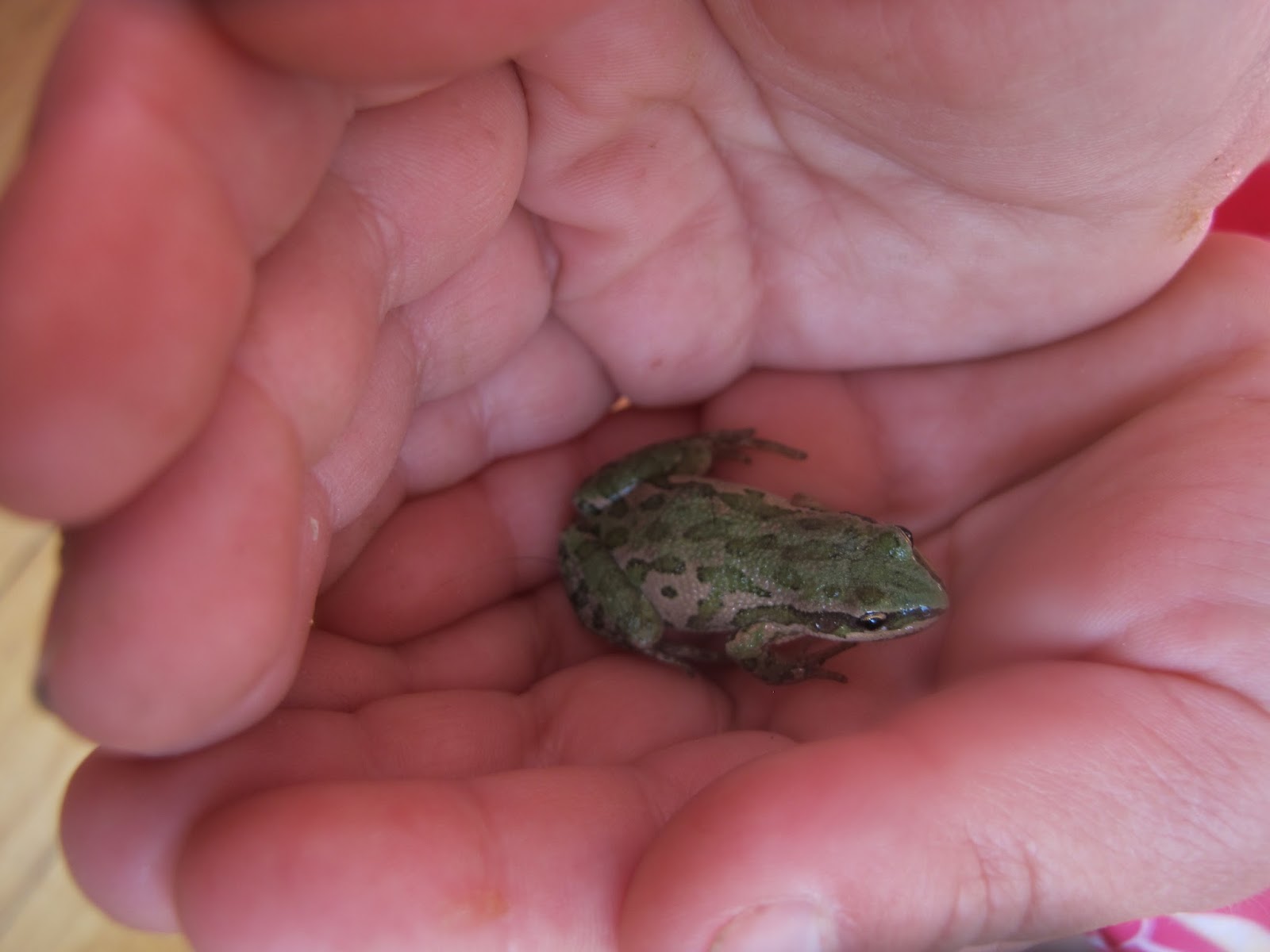
I recently discovered that my eldest daughter was conducting yet another set of science experiments (unbeknownst to me). In the past D. has made balls from toilet paper she has painstakingly coloured with markers and then soaked. She has made concoctions from berries and leaves and dirt and flour stolen from the kitchen, sweetening the mess by adding sticky hard candy, the remnants of Halloween. Like any good absent-minded inventor, she moves on to the next question, the next project, leaving me with a puzzling collection of bacteria to discover under the bed. Her latest idea was to clean rainwater by using a pot of dirt (of all things) as a filter, followed by rocks, and then paper. D. conducted her experiment in the bathroom, and I'll admit I nearly lost my temper upon encountering a random and seemingly pointless mess.
Fortunately, she was able to explain this project to me, and to beg me to take her to a thrift store so that she could purchase her very own funnel. Her bright enthusiasm warmed my heart. I thought back to my own childhood. My mother, for brief window of time, attempted to put the household in order--to raise children who would put things in their places. Fortunately for me, she quickly realized that she was raising a family of inventors, and dabblers, and hobbyists, and avid animal collectors, and messy painters of enormous canvases, and she decided that living was more important than cleaning. And so we children discovered our worlds, and ourselves, within a happy and disorderly environment.
So, while I strive to keep the frog in its enclosure, and the piles of dirt in the outside world, I savour these moments with children who invent, and discover, and misplace, and forget, and grow bigger all the while.
June 22, 2015
An Ode to Señora Mantissa (a.k.a. "Maria")
Every day, pajama-clad or otherwise, I walk out onto my balcony, a white net in hand. If observed, I might appear to be a lunatic.
The assumption might very well be correct, and it wouldn't be the first time. (I recall going rabbit hunting in a back alley a couple of years back. My daughter was carrying a fishing net and wearing some bizarre assortment of clothing--a bicycle helmet, perhaps, with shorts and a raincoat and her favourite green goggles. My choice of clothing wasn't much better.)
This time, however, my quarry is not rodent. It is the common house fly.
Thanks to a science-loving neighbour, our household is currently raising four praying mantises. And they are making me terribly nostalgic: I lovingly reared a mantis into adulthood when I was a young teenager in a room lined with snake tanks and salamanders, turtles, and fish. That summer, my little brother and I spent much of our time in the washrooms of family camp and various campgrounds catching dozens of flies to feed to our dear pets. Mine thrived; his was left in the hot sun by a mantis-sitter whose mother didn't want an insect in the house. (Poor Brent has never forgotten this betrayal.)
Mantises are voracious predators (though harmless to humans). What draws me in even today is how their savagery is combined with seemingly impeccable manners. They say "grace," as my little daughter observed. They eat blue bottles like corn on the cob, often stopping to casually groom one arm even as their half-eaten meal struggles in the other. They eat slowly, and with relish. Just yesterday a mantis began his meal by delicately eating the foot off a fly, much like a human might pick at the choicest bit of meat.
Unfortunately (and where humans might grow queasy), their prey is alive. These insects are not known for their empathy. And at the end of the meal, the bottom of the jar is lined with discarded wings and legs.
But really, how different is that from chicken wings at the local pub?
These unusual pets have brought great joy to our household. "Maria" is the favourite by far. She is the most voracious mantis, staring longingly through the glass into the vase containing the flies of the more ambivalent "James" (formerly known as "Gary"). She repeatedly jumped onto the camera when I attempted to photograph her and loves walking across my children's faces, to their delight.

 |
| "Maria," hoping in vain for a fly |
 |
| Laid-back "James" (a.k.a. "Gary") just hanging out |
"Lola" and "Anna" (formerly known as "Lily" and "Billy" respectively) like to swivel their heads and stare at us. They're more cautious, more dainty, more willing to pick at the wingless fruit flies we offer than to attempt to wrestle down the blue bottles that Maria tackles.
 |
| Maria's impeccable table manners |
Mantises, I will confess, are highly addictive. They are much like video games: you must feed them to get to the next "level" or molt. (See Molting Mantis) And they're a lot like kids: they grow up so fast. One day they're nymphs, and the next they're the length of your hand and free to wander the house, picking flies off windows like teenagers popping potato chips into their mouths.
I still recall the day my childhood mantis passed. She was drooping, and when she refused to eat even a single fly, I knew something was terribly wrong. I left her on the fence that day, at one with nature. She died a few hours later. My science teacher, amazed by her impressive size, preserved the body in a jar of formaldehyde.
Call me eccentric, but I love sharing this passion with my children. And I have passed three additional mantises over to my delighted brothers. (How touching that whereas a neighbour once murdered an innocent mantis due to her belief that a mantis is not fit to live among humans, an entirely different neighbour is now spreading the mantis love, blessing her community with over a hundred voracious souls!)
One of the mantises I transported to Edmonton is now living among doctors in an undoubtedly expensive vase lined with the best mulch and branch that money can buy. The other two, forbidden to enter the house of my little brother due to the good sense of his wife, are now living at the Edmonton Journal, most likely providing great insight into the crime beat.
Subscribe to:
Posts (Atom)